|
|
 |
More people than you might imagine experience urinary incontinence (UI) at some point in their lives.
If that comes as a surprise, it's probably because UI - the sudden, unintentional release of urine - is
one of those things that no one finds particularly easy to talk about. It can be a nuisance. It can be
embarrassing. It can be uncomfortable. And sometimes, it is much more - UI can limit your quality of
life. You may end up restricting or avoiding physical activity, travel or social relationships because of
it. Consulting your urologist/doctor is the best thing to do.
What is urinary incontinence?
The bladder is a muscular bag that collects urine. It is located in the middle of the pelvis at the lowest
point in the abdomen. A small amount of urine drips constantly from your kidneys to your bladder
through tubes called ureters. The amount of urine made depends on a number of things including how
much you drink, eat and sweat.
The bladder relaxes and stretches like a balloon as it fills with urine. The bladder normally fills up
without you noticing to about 280ml of urine. A full bladder can contain much more.
The outlet for urine (the urethra) is normally kept closed even when it is under pressure from a full
bladder. The ring of muscle at the opening at the neck of the bladder is called the sphincter. The
muscles beneath the bladder that surround the urethra are called the pelvic floor muscles. Your pelvic
floor muscles help to hold your bladder and urethra in place. When these muscles get weak, it is hard
to stop urine from leaking out.
When you go to the toilet to pass urine, the bladder muscle contracts (squeezes), and the urethra and
pelvic floor muscles relax. Complex nerve messages are sent between the brain, the bladder, and the
pelvic floor muscles. These make you aware of how full your bladder is and tell the right muscles to
contract, or relax, at the right time.
If you have UI, either the muscles or the nerve supply are not working properly to control your bladder,
so you pass urine when you do not mean to. It can range from a small dribble' now and then, to large
floods of urine.
UI becomes more common as people get older although it does not only affect older people. It is twice
as common in women than men and affects many women who have had children.
Types of urinary incontinence
Stress incontinence
Stress incontinence is the most common type of incontinence. This is when a small amount of urine
leaks out during physical activity, including coughing, sneezing, laughing or heavy lifting. This is
because your pelvic floor muscles are weak and cannot tighten (contract) properly. Usually only a
little bit of urine leaks out but it can be very embarrassing, especially when you forgot to empty your
bladder before physical activity. This type of incontinence is common in women after having children or
after menopause. It may occur in men after radical removal of the prostate, radiation treatment or any
procedure that damages the sphincter.
Urge incontinence
Urge incontinence is the second most common type of incontinence. With this type of incontinence,
the bladder contracts involuntarily, leading to a loss of bladder control and the release of urine. This
happens because there is a problem with the messages between the brain and the bladder. The
bladder may feel fuller than it is and tells the brain it is full too early. The bladder muscle squeezes too
early and empties completely - often before you have a chance to get to a toilet.
Urge incontinence may happen during any activity, even when you sit still. People with urge
incontinence often go to the toilet a lot during the night.
Who is at risk?
Women
Causes stress incontinence:
Pregnancy
Injuring or straining the area when giving birth to a child.
The weakening of the muscles as you get older, especially
after the menopause
Lack of hormones causes atrophy of the mucosa.
Causes urge incontinence:
Infections of the bladder or urinary tract, including cystitis.
Sphincter disorders or neurological disorders that affect
the nerves including stroke, Parkinson's disease, brain
tumours, Multiple sclerosis, spinal cord injury.
Blockages caused by bladder stones or - very occasionally
- tumours.
An irritable or unstable bladder where the bladder muscle
tightens from time to time, pushing out a little urine into
the top of the urethra where the sphincter helps to keep
the tube closed. The pressure of urine at this point causes
a strong desire to relax the sphincter and pass urine.
Men
Stress and urge
incontinence may be
caused by prostate disease
treatments
Surgery removes the upper
sphincter and decreases the
resistance of the urethra.
Therefore exercises of these
muscles are recommended
before and after surgery to
keep the situation normal.
Physical exercise may cause
occasional drops.
What will happen at the doctor's?
Do not be embarrassed about going to see your
doctor about your incontinence. It may be useful to
keep a diary of your bladder habits because they
will ask you questions such as:
How often do you need to go to the toilet?
Do you need to go to the toilet during the night?
You may need to have some examinations and you
may be referred to a urologist. Tests may include:
Urinalysis
Urinary flow rate
Digital rectal examination (DRE)
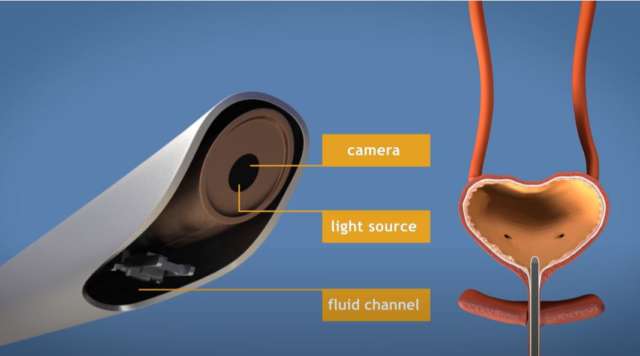
Cystoscopy (a procedure that uses a special
instrument, called a cystoscope, to examine the
inside of the bladder)
Sometimes specific tests of bladder function and
pressure are requested.
These tests will help your urologist verify the
correct diagnosis, ranging from infection to cancer.
What are the treatment options?
Women
Stress incontinence
Pelvic floor exercises (also known Kegel exercises) are
the best way to help strengthen the pelvic floor muscles.
Some people may be referred for treatment with electric
stimulators. These are used on your pelvic floor muscles to
help increase their strength.
Some women find that addition oestrogen improves
the strength and elasticity of their muscles, so hormone
replacement therapy may be a consideration.
If this brings no relief, cure can be brought by a surgical
repair procedure putting the organs involved back in place
by fixing them to the pelvic bone or increase the urethral
pressure by injections, lifting or sling procedures. An
example is tension-free vaginal tape (TVT) (see figure).
This involves placing a U-shaped piece of synthetic tape
underneath the urethra and stitching it to the abdominal
wall.
Urge incontinence
The best way to improve urge incontinence may be to retrain the bladder. Over time, you can
gradually stretch the bladder so that it can hold more urine. This means that you will have more
time to get to the toilet after you feel the urge and you are less likely to leak urine. Your doctor or
nurse will explain how to do bladder retraining.
There are drugs available to relax the bladder by blocking certain nerve impulses. These drugs are
called anticholinergics. They may have side effects so you should speak to your doctor about which
one will suit you best.
If you have a bladder infection it may respond to treatment with antibiotics.
Often, a combination of drugs and bladder retraining is the best treatment. Surgery, or treatment
with electric nerve stimulators, is occasionally used in the treatment of urge incontinence.
Men
Stress incontinence
If the exercises fail, sling
procedures or prosthesis are
a solution to strengthen or
replace the sphincter function.
Urge incontinence
The same procedures as those
used for women.
Conclusion
Urinary incontinence the loss of bladder control is a common and often
embarrassing problem. Although urinary incontinence affects millions of people, it
isn't a normal part of aging or, in women, an inevitable consequence of childbirth
or changes after menopause. It's a medical condition with many possible causes,
some relatively simple and self-limited and others more complex.
If you're having enough trouble with bladder control that it affects your day-to-day
activities, do not hesitate to see your urologist/doctor. In many situations, urinary
incontinence can be stopped.
|
|
|